7 Commercial Interior Design Value Proposition Tips
If you’ve ever walked into an office, retail store, or co-working space and instantly felt “this place gets it,” that’s not an accident. That’s the commercial interior design value proposition working in the background.
And here’s the thing most people miss: it’s not just about nice furniture or trendy lighting. It’s about how a space quietly influences behavior—how long customers stay, how employees feel, and how strongly a brand is remembered.
What the commercial interior design value proposition really means, why it matters for U.S. businesses, and how companies use it to improve productivity, branding, and revenue. You’ll also see what separates average design from strategic design that actually pays for itself.
Commercial interior design value proposition and why it matters in business strategy
The commercial interior design value proposition isn’t just a design concept—it’s a business strategy disguised as aesthetics. When done right, it connects space planning, branding, and user experience into one system that drives performance.
In simple terms, it answers this question: “What does your space do for your business besides look good?”
For example, a well-designed office doesn’t just impress visitors. It reduces distractions, improves collaboration, and helps employees stay longer and perform better. That’s direct business value, not decoration.
The same applies to retail and hospitality. A smart workspace optimization or layout strategy can increase customer dwell time, which often leads to higher spending. In workplaces, better lighting, acoustics, and flow can improve employee engagement workplace design outcomes.
Here’s why this matters: businesses in the U.S. are no longer competing only on products or services—they’re competing on experience. And experience is heavily shaped by space.
So when we talk about commercial interior design value proposition, we’re really talking about:
- How design supports revenue growth
- How space improves operational efficiency
- How environment reinforces brand identity
- How layout influences human behavior
What this means is simple: design is no longer the final step—it’s part of the business model.
Commercial interior design value proposition and ROI-driven workspace optimization
The strongest commercial interior design value proposition today is tied directly to ROI. Businesses want proof that design decisions actually impact performance, not just aesthetics.
Let’s break down how ROI shows up in real commercial spaces.
1. Productivity gains in office environments
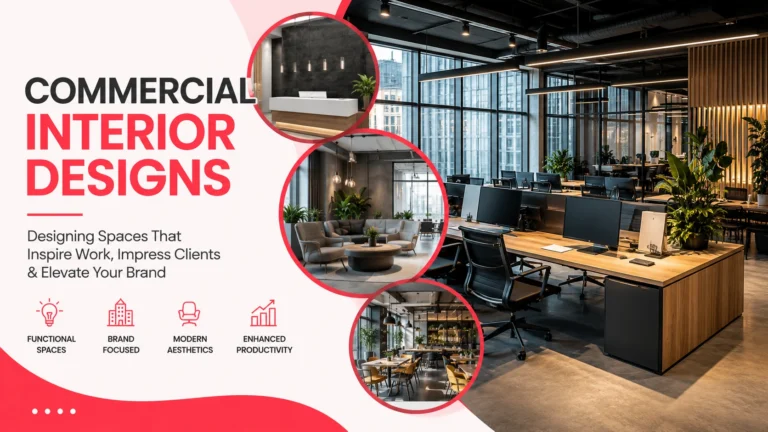
A well-planned office interior design strategy improves how people move, think, and collaborate. Open collaboration zones, quiet pods, and intuitive layouts reduce friction in daily work.
Studies from workplace research firms like Gensler consistently show productivity improvements of up to 20–25% in well-designed environments.
That’s not a small number. It’s the difference between a team struggling to keep up and a team operating smoothly.
2. Better customer experience in retail and service spaces
In retail, customer experience design is everything. If customers feel comfortable, they stay longer. If they stay longer, they tend to buy more.
That’s why brands invest heavily in branded environments—spaces designed to reflect identity while guiding customer behavior naturally.
Even subtle changes like aisle width, lighting temperature, or seating placement can influence purchasing decisions.
3. Space efficiency and cost control
Good space planning commercial buildings strategies also reduce wasted square footage. That means lower operational costs per employee or per customer.
This is especially important in high-rent U.S. cities where every square foot matters.
So when executives evaluate a commercial interior design value proposition, they’re increasingly asking:
- Will this layout reduce operational friction?
- Will it improve employee retention or performance?
- Will it increase revenue per square foot?
That shift is exactly why design is now treated like a financial decision.
Commercial interior design value proposition through branding and spatial experience
Another layer of the commercial interior design value proposition is branding—but not in the traditional sense of logos or colors.
This is about how people feel your brand in physical space.
Brand storytelling through interiors
A strong business interior branding strategy turns your space into a storytelling tool. Every element—from flooring to lighting—reinforces identity.
For example, a tech company might use open layouts and minimal design to signal transparency and innovation. A luxury brand might focus on textures, lighting contrast, and controlled movement to create exclusivity.
Spatial experience and emotional response
This is where spatial experience design becomes critical. People don’t just see a space—they experience it emotionally.
A confusing layout creates stress. A smooth, intuitive layout creates comfort.
That emotional response directly affects:
- Customer trust
- Employee satisfaction
- Time spent in space
- Brand perception
Design thinking in business decisions
Modern firms now apply design thinking in business to align spatial decisions with business goals. It’s not “what looks nice?” anymore—it’s “what behavior do we want to encourage?”
That mindset shift is what separates average design firms from high-performing ones.
Workplace wellbeing and employee engagement in commercial design
One of the fastest-growing parts of the commercial interior design value proposition is workplace wellbeing.
Businesses are realizing something simple but powerful: people don’t perform well in environments that feel draining.
Lighting, acoustics, and comfort
Small details matter more than most people think. Poor lighting causes fatigue. Bad acoustics reduce focus. Uncomfortable layouts slow down collaboration.
That’s why workplace wellbeing design has become a major focus in modern offices.
Reducing turnover through environment
A well-designed workspace can reduce employee turnover intention significantly. Some workplace studies suggest improvements of up to 30% when environment quality increases.
That translates directly into hiring and training cost savings.
Hybrid work and flexible spaces
Post-2020 workplace trends have also pushed companies toward corporate interior design trends focused on flexibility.
Spaces now need to support:
- Hybrid meetings
- Remote collaboration hubs
- Quiet focus zones
- Social interaction areas
This flexibility is now part of the commercial interior design value proposition, not an optional upgrade.
Commercial interior design value proposition in tenant improvement and real estate
In real estate, the commercial interior design value proposition plays a huge role in tenant attraction and retention.
Tenant improvement impact
A strong tenant improvement design can significantly increase property desirability. Businesses are more likely to lease spaces that already support their operational needs.
That reduces downtime and build-out costs for tenants.
Property value and leasing speed
Well-designed commercial spaces often lease faster and at higher rates. Why? Because they reduce friction for decision-makers.
If a business can “see themselves” in a space immediately, the leasing decision becomes easier.
Design-build efficiency
Integrated design-build commercial projects also streamline construction timelines. When design and execution teams work together, projects tend to move faster and with fewer costly changes.
That efficiency becomes part of the overall value proposition for developers and landlords.
FAQs
1. What is a commercial interior design value proposition?
It refers to the measurable business benefits of interior design, including productivity, branding, customer experience, and operational efficiency. It’s not just aesthetics—it’s how design supports business performance and revenue growth.
2. How does interior design improve workplace productivity?
A strong commercial interior design value proposition improves workflow, reduces distractions, and enhances collaboration. Better lighting, layout, and zoning can increase focus and efficiency across teams in measurable ways.
3. Is commercial interior design worth the investment?
Yes, because it impacts employee retention, customer behavior, and operational costs. Businesses often see improved performance metrics when space design aligns with business strategy and user experience goals.
4. How does design affect branding in commercial spaces?
Through business interior branding, every design element communicates identity. Layout, materials, and lighting influence how customers and employees emotionally perceive the brand.
5. What trends are shaping commercial interior design today?
Key trends include hybrid workplace design, wellness-focused layouts, flexible spaces, and data-driven workspace optimization strategies that improve both employee and customer experience.
Conclusion
At its core, the commercial interior design value proposition is about turning space into a business asset instead of a visual expense.
When design is aligned with strategy, it influences everything—productivity, branding, customer behavior, and even real estate value. That’s why modern businesses no longer ask, “How should this space look?” but instead ask, “What should this space do for us?”
If you’re evaluating a redesign or new build, start by thinking beyond aesthetics. Look at flow, behavior, and outcomes. Because in the end, the best-designed spaces are the ones that quietly improve business performance every single day.